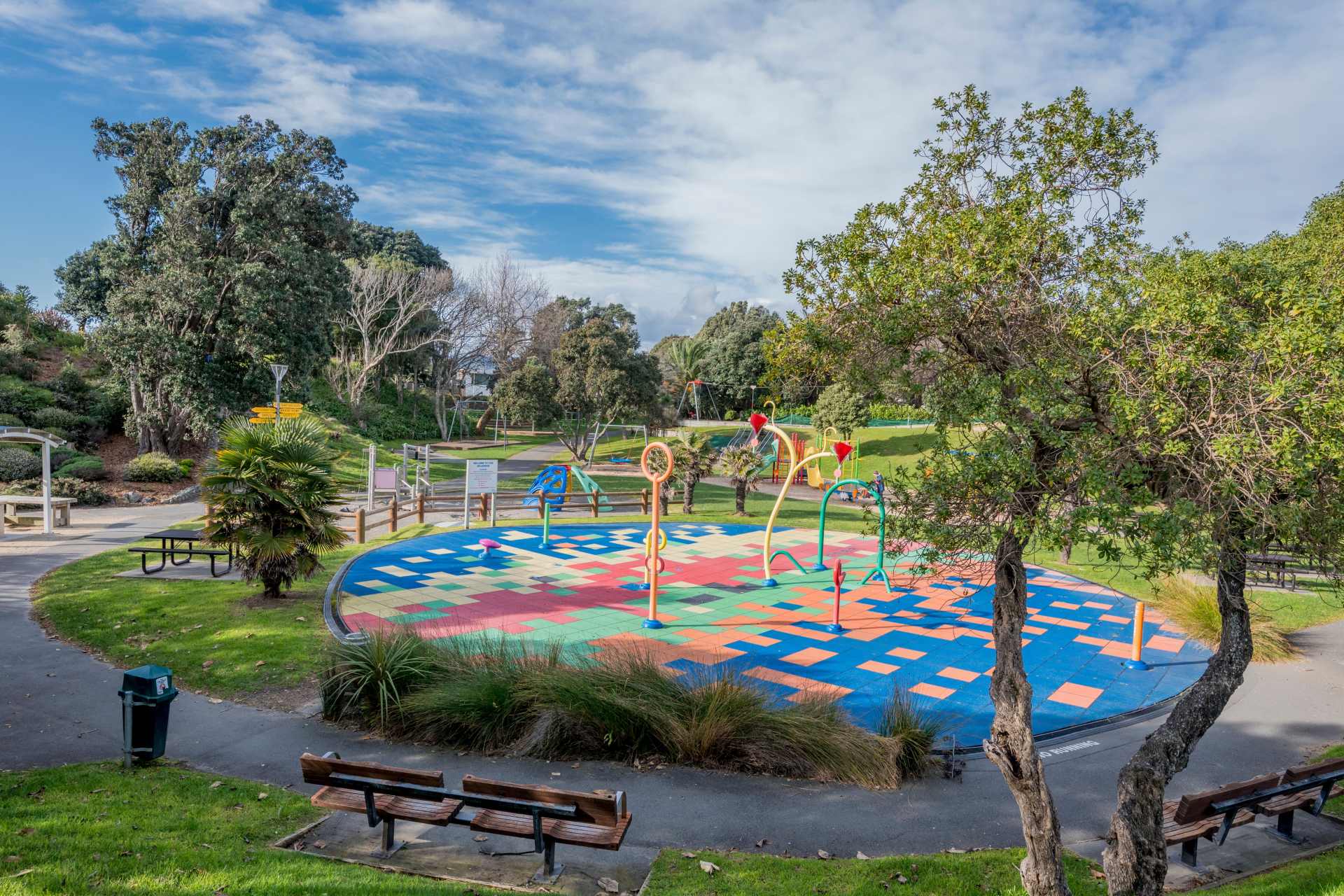
When a recent UK investigation detected glyphosate residues in children’s playgrounds, it reignited a familiar debate:
How a chemical classified as probably carcinogenic continues to be used in places designed for play.
The testing found glyphosate not just in surrounding soil, but on playground surfaces and equipment — areas where children crawl, touch, and put their hands in their mouths. The only playgrounds that tested clear were in councils that had already stopped using the chemical.
Those findings may feel distant, but the questions they raise are not. Here in New Zealand, glyphosate is routinely used in public spaces, including parks, sports fields, and playgrounds — often without any testing to confirm what residues remain after spraying.
That concern surfaced recently during Whangārei District Council’s recent glyphosate debate, where councillors and residents questioned the routine spraying of public areas without residue monitoring or long-term exposure assessment. The discussion echoed a wider unease: if we’re not testing, how can we be so certain about what’s left behind?
And that leads to the harder question: why would we assume New Zealand’s playgrounds are any different?
Glyphosate Found in UK Playgrounds: What the Testing Revealed
In the UK, independent testing detected glyphosate residues in the majority of playgrounds sampled. Not just in soil at the margins, but on play surfaces and equipment — areas where children crawl, touch, and put their hands in their mouths.
The one clear exception? Councils that had already stopped using glyphosate.
This matters, because it shows something important: contamination is not inevitable. Where the chemical isn’t used, residues don’t appear.
That finding alone challenges a common assumption — that glyphosate “doesn’t linger” or “breaks down quickly enough to be irrelevant.” If that were consistently true, residues wouldn’t be showing up at all.
Widespread Glyphosate Use in New Zealand, Little Public Testing
In New Zealand, glyphosate use is routine. Yet meaningful residue testing in public spaces is almost nonexistent.
Councils often rely on assurances:
- that products are used “according to label directions”
- that application rates are “within regulatory limits”
- that glyphosate has a long history of approval
But none of those statements answer a basic question:
What actually remains on the ground, on equipment, and in the environments where children play?
Without testing, we don’t know — and that uncertainty is doing a lot of heavy lifting.
Why Glyphosate Exposure Risks Are Different for Children
This is where the precautionary principle becomes relevant, not ideological.
Children have:
- developing organs and immune systems
- higher exposure per body weight
- frequent hand-to-mouth behaviour
- closer contact with ground-level surfaces
Even regulators acknowledge that children experience exposure differently. Yet policy decisions often treat playgrounds the same as roadside verges or industrial areas — simply another surface to be “managed.”
If glyphosate were found on playground equipment via food-contact testing standards, the response would likely be immediate. But because this exposure comes through public space maintenance, it’s treated as background noise.
Glyphosate and Cancer Risk: Why the IARC Classification Still Matters
Glyphosate’s classification by the International Agency for Research on Cancer (IARC) as probably carcinogenic to humans is now a decade old. It hasn’t been reversed. It hasn’t been withdrawn.
Instead, it has been talked around — framed as controversial, outdated, or misunderstood.
But the classification was based on:
- evidence of cancer in animal studies
- strong evidence of genotoxicity
- mechanisms relevant to human biology
That doesn’t mean every exposure causes harm. It does mean casual, repeated exposure — especially in children’s environments — deserves scrutiny, not dismissal.
Local Councils and Glyphosate Use: Policy Choices in Public Spaces
When councils continue to use glyphosate in playgrounds, they are making a decision — even if it’s framed as “business as usual.”
They are deciding:
- convenience over caution
- cost over uncertainty
- chemical control over non-chemical alternatives
Some councils overseas — and increasingly at home — have chosen differently. They’ve adopted mechanical weed control, hot water systems, mulching, or redesigned landscaping that reduces weed pressure altogether.
Those approaches aren’t perfect. But neither is spraying.
Have New Zealand Playgrounds Been Tested for Glyphosate?
After Whangārei District Council’s recent debate, and in light of international findings, the real issue isn’t whether glyphosate is allowed.
It’s this:
If we haven’t tested our playgrounds, why are we so confident about what’s not there?
Confidence without data isn’t evidence. It’s habit.
What This Means for Glyphosate Use in New Zealand Playgrounds
New Zealand prides itself on protecting children, valuing the outdoors, and taking a “clean, green” approach to public health. Those values sit uneasily beside the routine spraying of a chemical linked to cancer in spaces designed for play.
No one is suggesting panic. But complacency isn’t neutral — it’s a choice.
If councils are confident glyphosate poses no risk in playgrounds, then testing should be welcomed, not resisted. And if residues are found, the response shouldn’t be surprise — it should be accountability.
Because once you know children are being exposed, not asking questions becomes the bigger risk.
Resources & References
The questions raised here are not unique to New Zealand. Around the world, researchers, journalists, and public health bodies are grappling with the same issue: how a widely used chemical came to be normalised in everyday spaces, long before the science was settled. The sources below offer additional context — not as definitive answers, but as part of a broader conversation about exposure, evidence, and responsibility.
Glyphosate detected in UK playgrounds, campaigners warn
The Guardian (2026)
An investigation by The Guardian reporting on independent testing that detected glyphosate residues in UK playgrounds, prompting renewed debate over the safety of chemical weed control in areas used by children.
https://www.theguardian.com/environment/2026/jan/15/glyphosate-cancer-linked-pesticide-uk-playgrounds
IARC Monographs: Glyphosate
International Agency for Research on Cancer (2015)
The official assessment that classified glyphosate as “probably carcinogenic to humans,” based on animal studies, mechanistic evidence, and limited human data.
https://www.iarc.who.int/featured-news/media-centre-iarc-news-glyphosate/
Why Some Councils Are Phasing Out Glyphosate
Pesticides Action Network UK
An overview of why multiple councils have chosen non-chemical weed control methods, including cost comparisons, exposure concerns, and public pressure.
https://www.pan-uk.org/health/glyphosate/
WHO: Children’s Exposure to Chemicals of Concern
World Health Organization
An overview of why children are more vulnerable to environmental hazards, including hazardous chemicals, due to developmental, behavioural, and physiological factors.
https://www.who.int/health-topics/children-environmental-health#tab=tab_1
Taken together, these perspectives don’t point to a single conclusion — but they do reinforce one thing: when it comes to chemicals used where children play, certainty should be earned through evidence, not assumed through habit.
Image Source & Attribution
We’re grateful to the talented photographers and designers whose work enhances our content. The feature image on this page is by wirestock_creators.