A cancer diagnosed at 35 may carry evidence of biological events that began decades earlier.
That possibility is emerging from remarkable new research into early-onset colorectal cancer. Scientists have found molecular fingerprints of DNA damage that appear to have been laid down much earlier in life — potentially during childhood — long before the cancer itself developed.
The finding has nothing directly to do with glyphosate.
But it raises an important question about how we investigate the long-term effects of environmental exposures.
What if the time that matters isn’t when disease appears, but years — or even decades — earlier?
For glyphosate, that question may take us back even further than childhood. Recent research we have reported on found glyphosate in the amniotic fluid surrounding developing rat fetuses following maternal exposure.
And that presents another problem.
If an exposure during pregnancy or childhood contributes to disease decades later, researchers somehow need to know that exposure occurred.
By the time the disease appears, it is too late to go back and measure it.
Yet New Zealand has no routine national population biomonitoring programme for glyphosate or its metabolite AMPA that could begin building the population-level exposure record researchers would need.
So how would we ever discover such an effect if one exists?
A Clue Hidden Inside Cancer DNA
In 2025, researchers published a major study in Nature examining the genomes of colorectal cancers from 981 patients across 11 countries.
They were looking for mutational signatures — distinctive patterns of DNA damage that can provide clues about processes that occurred during the development of a cancer.
One finding stood out in younger patients.
The researchers found signatures associated with colibactin, a genotoxin produced by certain strains of bacteria, including some strains of E. coli.
Those colibactin-associated signatures were 3.3 times more common in colorectal cancers diagnosed before age 40 than in cancers diagnosed after age 70.
But perhaps the most intriguing finding concerned timing.
The signatures were enriched among mutations that occurred early in the development of the cancers. The researchers also pointed to previous evidence indicating that colibactin-induced mutations can occur during the first decade of life and then cease.
In some cases, they explained, that early burst of mutations could give affected colorectal cells the equivalent of decades of additional mutation accumulation — effectively giving them a “head start”.
One particularly important target was APC, a tumour-suppressor gene that helps control cell growth and is frequently mutated early in the development of colorectal cancer. The researchers proposed that a colibactin-induced APC mutation early in life could put someone years ahead in the sequence of events that can eventually lead to colorectal cancer.
They were also clear that further research is needed to establish causality.
In other words, some of the biological groundwork for a cancer diagnosed in adulthood may have been laid much earlier.
That does not tell us that glyphosate — or any pesticide — was responsible.
But it changes the way we need to think about environmental exposure.
What Happens to the Developing Gut?
Our gut contains a vast community of bacteria and other microorganisms collectively known as the microbiome.
These organisms are involved in digestion, metabolism, immune regulation and maintaining the intestinal barrier.
The microbiome is not fixed. It develops rapidly during infancy and childhood, influenced by factors including how a baby is delivered, breastfeeding, diet, antibiotics and the surrounding environment.
There is experimental evidence that glyphosate and glyphosate-based herbicides can affect intestinal microbial communities.
A 2024 systematic review published in Food & Function examined experimental research into glyphosate exposure and the gut. The studies reviewed reported changes involving microbial composition and metabolism, intestinal permeability, mucus secretion and intestinal structure.
There is an important limitation.
Much of this evidence comes from animal and laboratory studies. It does not demonstrate that the levels of glyphosate people encounter through ordinary dietary exposure cause clinically important microbiome changes in humans.
Nor has science established a chain in which glyphosate disrupts the microbiome, promotes colibactin-producing bacteria and ultimately causes colorectal cancer.
But what if there is a connection we simply haven’t identified yet?
The absence of a demonstrated pathway is not evidence that no pathway exists. It means the pieces have not yet been connected.
And that leaves a question worth investigating:
Could exposure to glyphosate during critical periods of development alter biological systems in ways that matter much later in life?
Glyphosate Exposure Can Begin Before Birth
Even describing this as a childhood question may be starting too late.
As we reported recently, researchers studying glyphosate exposure during pregnancy detected glyphosate in the amniotic fluid surrounding developing rat fetuses.
The 2026 study exposed pregnant Wistar rats to glyphosate alone or a glyphosate-based herbicide at 2 mg glyphosate/kg body weight/day from day nine of pregnancy until their offspring were weaned.
Researchers reported changes in intrauterine oxidative balance across generations. Second-generation fetuses showed intrauterine growth restriction, while male offspring showed greater vulnerability in postnatal growth and survival.
This was an animal experiment.
It does not demonstrate that the same effects occur during human pregnancy, nor does it tell us what level of human exposure would produce an effect, if any.
But the detection of glyphosate in amniotic fluid established something important within that experimental model:
Maternal exposure did not stop with the mother. Glyphosate reached the fetal environment.
That matters when thinking about timing.
During pregnancy, cells are rapidly dividing and differentiating, organs are forming and biological systems are developing.
An exposure occurring during that period is not necessarily biologically equivalent to the same exposure occurring in a fully developed adult.
Perhaps, then, there are two questions to ask about an exposure.
How much?
And:
When?
What Have Human Cell Studies Found?
There is another reason we think this deserves attention.
Just days ago, we reported on a peer-reviewed study using human intestinal cells.
Researchers exposed the cells to glyphosate at concentrations ranging from 0.01 to 100 mg/L and measured micronuclei — small structures containing chromosome fragments or whole chromosomes that have not been properly incorporated into the nuclei of new cells during cell division.
Micronuclei are a recognised marker of genotoxic effects.
The researchers found significantly increased micronuclei at every glyphosate concentration tested, including the lowest concentration of 0.01 mg/L.
Again, there is an important distinction.
Cells growing in a laboratory dish are not a human body, and a concentration used in a cell experiment cannot simply be equated with the amount of glyphosate someone consumes in food.
The study therefore does not demonstrate that glyphosate residues at 0.01 mg/L in food or drinking water will damage someone’s chromosomes.
But nor should that limitation make the finding unimportant.
The researchers observed a genotoxic effect at every concentration they tested. That tells us something about what glyphosate is biologically capable of doing under those experimental conditions — and gives researchers another reason to investigate whether, and under what circumstances, such effects could matter in people.
The Genotoxicity Evidence Isn’t All One Way
That intestinal-cell study does not stand alone.
A 2024 study in Chemosphere, for example, exposed cultured human lymphocytes to glyphosate and its metabolite AMPA at concentrations ranging from 0.0125 to 0.500 μg/mL.
Researchers reported increased micronuclei following glyphosate and AMPA exposure from 0.050 μg/mL upwards.
Other experiments have also reported DNA or chromosome-related effects.
But importantly, not every study has.
A 2023 study published in Environmental and Molecular Mutagenesis tested glyphosate, AMPA and several glyphosate-based formulations using bacterial and human-cell assays.
The researchers did not find glyphosate or AMPA to be genotoxic under the conditions tested, while some formulated herbicides showed cytotoxic or genotoxic activity.
The genotoxicity evidence is therefore not a simple story in which every experiment produces the same result. Findings differ according to the biological system, concentration, exposure duration, assay and whether researchers test glyphosate itself or a commercial formulation.
That uncertainty is important.
So too is the fact that researchers are also looking for biological signals in exposed people.
What Are Researchers Finding in Exposed People?
Researchers from the US Agricultural Health Study have examined biological markers in people with differing glyphosate exposures.
In a 2023 study of 268 male farmers and 100 matched non-farmers, researchers measured glyphosate and biomarkers of oxidative stress in urine.
Higher urinary glyphosate concentrations were associated with higher levels of 8-hydroxy-2′-deoxyguanosine (8-OHdG), a marker of oxidative DNA damage. Participants in the highest urinary glyphosate quartile had approximately 15% higher 8-OHdG levels than those in the lowest quartile after adjustment for other factors.
More recently, researchers examined another marker known as mosaic loss of chromosome Y, or mLOY.
This occurs when some cells in a man’s body lose the Y chromosome as they divide and is considered a marker of genomic instability.
In a 2025 Agricultural Health Study analysis involving 1,868 male pesticide applicators, high intensity-weighted lifetime glyphosate use was associated with greater odds of mLOY in DNA collected from cells in the mouth.
Associations were stronger when mLOY affected a higher proportion of cells, although the exposure-response trend tests were not statistically significant.
These findings need to be interpreted cautiously.
8-OHdG and mLOY are biomarkers. They do not demonstrate that glyphosate caused cancer, nor do they establish that someone with these markers will develop cancer.
But they provide another reason to investigate what glyphosate exposure may be doing biologically in exposed human populations.
Glyphosate and Early-Onset Colorectal Cancer
In 2026, researchers approached the question from a very different direction — population-level mortality data.
Researchers examined 108,315 deaths from early-onset colorectal cancer in the United States between 1989 and 2023.
Their study, presented at the 2026 American Association for Cancer Research Annual Meeting and published as an abstract in Cancer Research, compared mortality with estimated agricultural glyphosate use at county level.
They reported a statistically significant dose-response association.
Counties in the highest category of glyphosate use had an approximately 10% higher adjusted early-onset colorectal cancer mortality rate than counties in the lowest category.
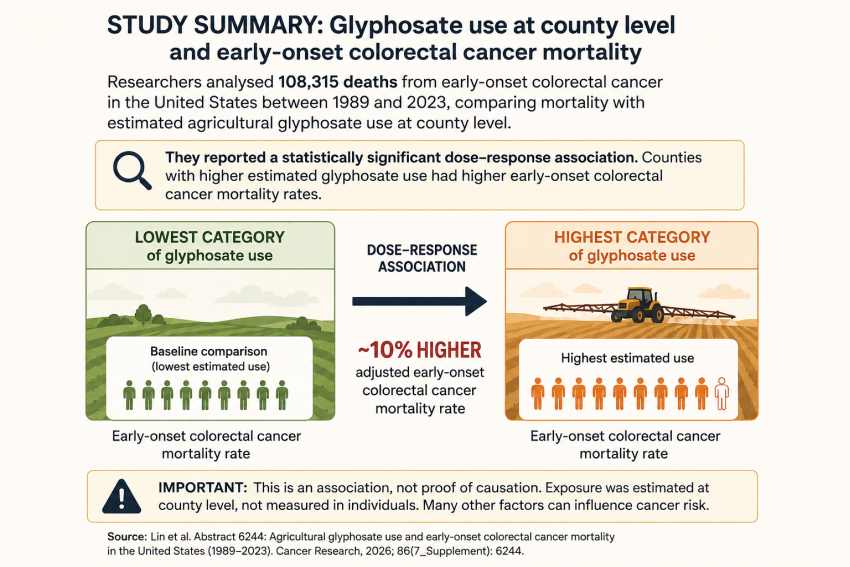
This does not establish that glyphosate caused those cancers.
It is an ecological study. Researchers linked agricultural pesticide-use estimates to the year and county where each person lived when they died. They did not measure the lifetime glyphosate exposure of the individuals who developed colorectal cancer.
Where someone lived when they died is not the same thing as knowing how much glyphosate entered their body.
And it certainly does not tell us how much glyphosate they were exposed to during pregnancy, infancy or childhood.
The researchers themselves called for further research using colorectal cancer incidence and life-course exposures based on residential address histories.
And that leads to a much bigger problem.
How Do You Investigate an Exposure That Happened 30 Years Ago?
Imagine that someone develops colorectal cancer at 35.
Researchers want to know whether environmental exposures during development played any part.
What was that person’s glyphosate exposure at 25?
At 15?
At five?
What was their mother’s exposure while she was pregnant with them?
We cannot go back and collect those samples.
Researchers can reconstruct possible exposure using agricultural pesticide-use records, occupation, residential history, diet and other information.
Those methods are valuable.
But they are not the same as having measured what actually entered people’s bodies at the time.
And that becomes particularly important when scientists are investigating diseases with long latency periods.
What Would New Zealand Know?
This brings the question very close to home.
New Zealand regulates glyphosate. We set maximum residue limits for food, and New Zealand Food Safety tests selected foods and agricultural products for glyphosate residues.
But testing food is different from systematically measuring human exposure.
New Zealand has no routine national population biomonitoring programme for glyphosate or its metabolite AMPA.
There has been some research involving New Zealanders. In a 2022 Australian-led study, researchers from the University of Queensland and collaborating institutions analysed urine from 27 occupationally exposed New Zealand farmers.
Glyphosate was detected in 96% of them and AMPA in 33%.
That is useful research — but it is not population biomonitoring.
Twenty-seven occupationally exposed farmers cannot tell us what typical glyphosate exposure looks like across the New Zealand population.
They cannot tell us how exposure differs between urban and rural communities, between adults and children, or during pregnancy.
And they cannot provide the repeated measurements over time that would allow researchers to build exposure histories.
That distinction matters.
Food residue testing tells us what was present in the particular foods sampled.
Human biomonitoring tells us something different:
What actually made it into people’s bodies around the time the samples were collected.
Without those measurements, an important part of our exposure history simply isn’t being recorded.
What About the People Who Believe Exposure Has Already Affected Them?
There is another part of this story that is much harder to interpret.
People sometimes report becoming unwell following occupational, residential or other exposure to glyphosate and glyphosate-based herbicides. For the person experiencing it, the sequence can seem compelling: there was an exposure, and illness followed.
But establishing what caused an individual’s illness years later is extraordinarily difficult.
People are not exposed to one thing at a time. Across a lifetime we encounter vehicle exhaust, household and workplace chemicals, pesticides, air pollution, medications, infections and many other environmental influences. Genetics, lifestyle and chance also play a part.
So someone’s experience cannot, by itself, establish that glyphosate caused their illness.
But neither does our inability to prove the connection tell us that there wasn’t one.
This is another version of the same problem.
If nobody measured that person’s glyphosate exposure when it occurred, researchers looking back years later may have little more than memories, occupational histories and estimates from where they lived or worked.
We may therefore be seeing genuine health effects associated with past environmental exposures without yet having the information needed to identify which exposure — or combination of exposures — mattered.
Some suspected connections may turn out not to be causal. Others may eventually be supported by stronger evidence.
The difficulty is knowing which is which.
And without measuring exposure, we make that already difficult task considerably harder.
These Studies Do Not Form a Causal Chain
This point is important enough to state plainly.
The studies discussed here do not prove that glyphosate exposure in the womb or during childhood causes colorectal cancer.
They do not demonstrate that glyphosate-induced microbiome changes lead to colibactin exposure.
They do not establish that the chromosome effects observed in cultured cells occur in people consuming ordinary dietary residues.
The human biomarker studies show associations, not proof that glyphosate caused the biological changes observed.
And an association between agricultural glyphosate use and colorectal cancer mortality does not demonstrate that glyphosate caused those deaths.
These are different studies, asking different questions, using different methods.
They should not be joined together and presented as though scientists have demonstrated a single pathway from glyphosate exposure before birth to cancer decades later.
They haven’t.
But that does not make the individual findings irrelevant to one another.
Together, they illustrate why timing and latency matter.
We know that glyphosate can reach the fetal environment in an experimental animal model.
We have experimental evidence that glyphosate and glyphosate-based herbicides can alter intestinal microbial communities.
We have studies reporting genotoxic effects in human cells, alongside other studies that have not found such effects under the conditions tested.
We have human biomarker studies reporting associations between glyphosate exposure and markers related to oxidative DNA damage and genomic instability.
We have evidence that a bacterial genotoxin can leave a distinctive mutational fingerprint particularly associated with colorectal cancers occurring in younger people — and evidence suggesting that some of that damage can originate much earlier in life.
And we now have population-level research reporting an association between agricultural glyphosate use and early-onset colorectal cancer mortality.
None proves the next.
But neither does the absence of a proven chain tell us that there is no connection.
What we have are pieces of evidence from different fields that have not yet been joined together. Some connections may eventually prove important. Others may prove unrelated.
We don’t yet know.
And that is precisely why collecting exposure information now matters.
Perhaps We’re Asking the Wrong Question
Chemical safety is often discussed in terms of dose.
How much exposure occurred?
Was it above or below a regulatory limit?
Was there a measurable adverse effect?
Those are important questions.
But research into developmental exposures and diseases with long latency adds another:
When did the exposure occur?
An exposure during pregnancy may not be biologically equivalent to the same exposure during adulthood.
An exposure during infancy or childhood occurs while biological systems are still developing.
And if some consequences of environmental exposure do not become apparent until decades later, waiting for disease to emerge before looking for exposure creates an obvious problem.
By then, the opportunity to measure the original exposure is gone.
That leaves New Zealand with a question that goes beyond whether today’s regulatory limits for glyphosate are considered safe:
Are we collecting enough information today to discover if our assumptions turn out to be wrong tomorrow?
Because if scientists eventually discover that glyphosate exposure during pregnancy, infancy or childhood contributes to disease decades later, there is one thing we will not be able to do.
We will not be able to go back and measure it.
Resources & References
The studies discussed in this article do not provide a single, proven pathway from early-life glyphosate exposure to disease decades later.
What they do provide are pieces of a much larger question: evidence about when some cancer-associated DNA damage may begin, what glyphosate can do in experimental systems, what researchers are finding in exposed people, and just how difficult it is to connect an exposure today with a disease that may not appear for decades.
Here are the key studies behind that discussion.
Geographic and age variations in mutational processes in colorectal cancer
Díaz-Gay M., et al. Nature, 2025.
Examined 981 colorectal cancer genomes from 11 countries and found that mutational signatures associated with the bacterial genotoxin colibactin were substantially more common in cancers diagnosed before age 40. The research provides important evidence that some of the mutational groundwork associated with colorectal cancer may be laid much earlier in life.
Effects of glyphosate exposure on intestinal microbiota, metabolism and microstructure: a systematic review
Ignácio A.C., et al. Food & Function, 2024.
Reviewed experimental research into glyphosate and the gut, finding reported changes involving microbial composition and metabolism, intestinal permeability, mucus secretion and intestinal structure. Much of the evidence comes from animal and laboratory studies, so it does not establish comparable effects from ordinary human dietary exposure.
Multigenerational effects of perinatal glyphosate exposure in rats: Developmental alterations, increased mortality and oxidative imbalance
Almirón A., et al. Environmental Toxicology and Pharmacology, 2026.
Found glyphosate in the amniotic fluid of exposed pregnant rats, demonstrating that maternal exposure reached the fetal environment in this experimental model. Researchers also reported developmental and oxidative-balance effects across generations, including fetal growth restriction in the second generation.
In vitro genomic damage caused by glyphosate and its metabolite AMPA
Santovito A., et al. Chemosphere, 2024.
Examined glyphosate and AMPA in cultured human lymphocytes and reported increased micronuclei at concentrations from 0.050 μg/mL upwards — adding to experimental evidence that glyphosate can produce chromosome-related effects under some laboratory conditions.
Evaluation of the herbicide glyphosate, AMPA, and glyphosate-based formulations for genotoxic activity using in vitro assays
Smith-Roe S.L., et al. Environmental and Molecular Mutagenesis, 2023.
Provides an important counterpoint. Researchers did not find glyphosate or AMPA to be genotoxic in the bacterial and human-cell assays used, although some formulated herbicides showed cytotoxic or genotoxic activity. It is a useful reminder that the experimental genotoxicity literature does not all point in the same direction.
Glyphosate exposure and urinary oxidative stress biomarkers in the Agricultural Health Study
Chang V.C., et al. Journal of the National Cancer Institute, 2023.
Found that higher urinary glyphosate concentrations were associated with higher levels of 8-OHdG, a biomarker of oxidative DNA damage, among participants in the Agricultural Health Study. The finding is an association with a biological marker — not evidence that glyphosate caused cancer.
The association between glyphosate use and mosaic loss of chromosome Y in buccal samples among male pesticide applicators in the Agricultural Health Study
Chang V.C., et al. Environment International, 2025.
Reported an association between higher intensity-weighted lifetime glyphosate use and mosaic loss of chromosome Y, a marker of genomic instability, among male pesticide applicators. Associations were stronger for higher levels of mLOY, although exposure-response trend tests were not statistically significant.
Agricultural glyphosate use and early-onset colorectal cancer mortality in the United States
Lin J., et al. Cancer Research, 2026, conference abstract.
Examined 108,315 early-onset colorectal cancer deaths and reported higher mortality rates in US counties with greater estimated agricultural glyphosate use. Because this was an ecological mortality study rather than a study of individual lifetime exposure, it cannot establish that glyphosate caused those cancers.
Multiple Pesticides and their Mixtures Tested for Genotoxicity in the Micronucleus Assays on Intestinal Caco-2 Cells
Truzzi F., Tibaldi E., Noferini R., et al. Annals of Global Health, 2026.
Tested pesticides individually and in mixtures using Caco-2 human intestinal cells. Glyphosate significantly increased micronuclei at every concentration tested, from 0.01 to 100 mg/L. This was an in-vitro experiment and does not establish that equivalent residues in food or drinking water produce chromosome damage in people.
Characterization of glyphosate and AMPA concentrations in the urine of Australian and New Zealand populations
Campbell G., et al. Science of the Total Environment, 2022.
Analysed urine from 27 occupationally exposed New Zealand farmers alongside pooled Australian population samples. Glyphosate was detected in 96% of the New Zealand farmers and AMPA in 33%. The New Zealand sample provides useful evidence of occupational exposure but is not representative population biomonitoring.
Taken separately, these studies answer different questions.
Taken together, they leave us with a question science cannot yet answer:
Could an exposure during a critical period of development leave biological consequences that do not become apparent until many years later?
We do not know.
But if answering that question someday requires knowing what people were exposed to during pregnancy, infancy or childhood, the measurements we fail to make today cannot be recovered decades from now.
Image Source & Attribution
We’re grateful to the talented photographers and designers whose work enhances our content. The feature image on this page is by Getty Images. You can find more of their work here: https://unsplash.com/@gettyimages.