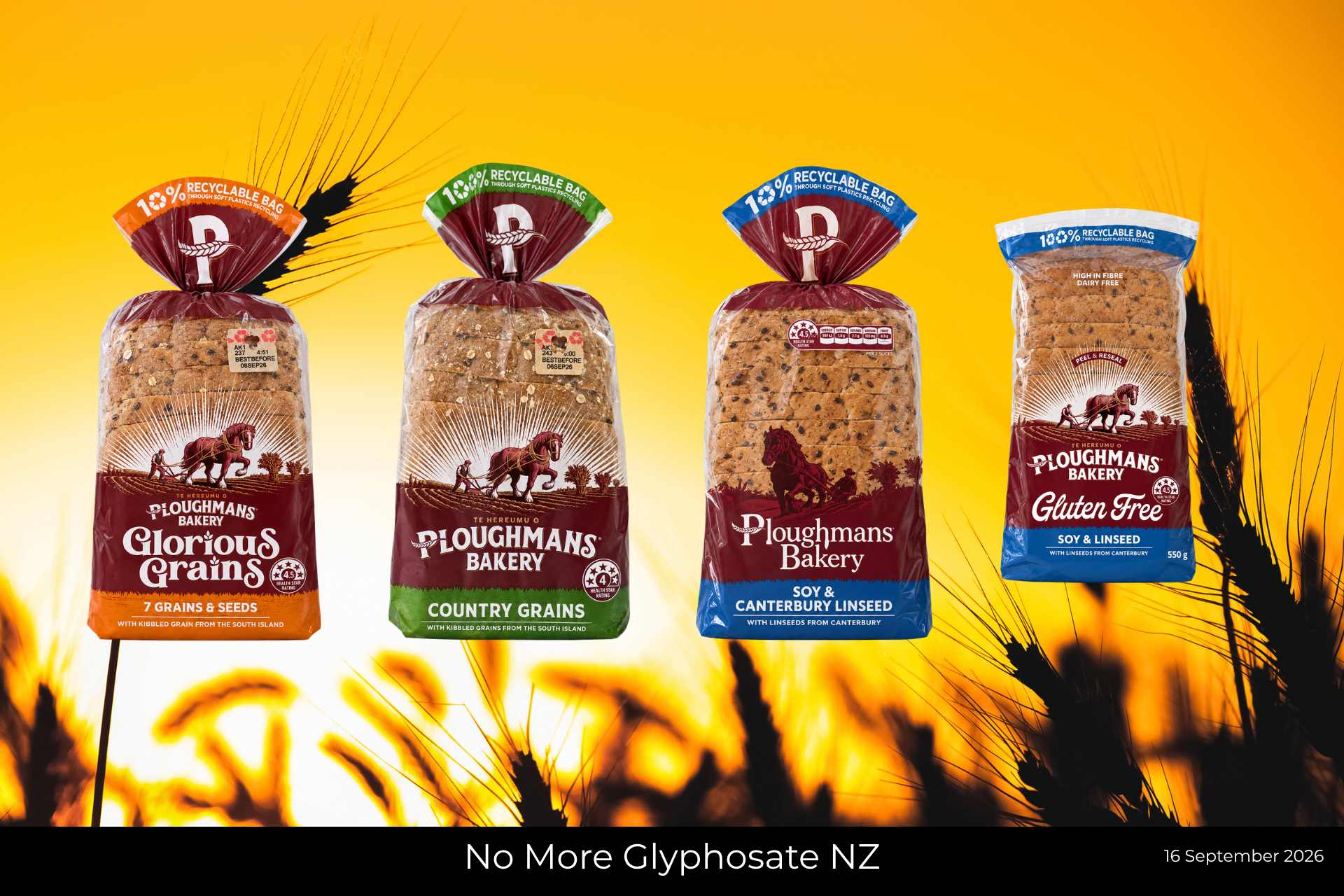
Four Ploughman’s breads. Four different products.
Glyphosate was detected in every one.
For our latest round of independent supermarket bread testing, we selected four products from the Ploughman’s range and sent samples to Hill Laboratories for glyphosate analysis.
The results ranged from 0.016 mg/kg (16 ppb) to 0.043 mg/kg (43 ppb).
Those aren’t the highest levels we’ve found in bread.
But four different products — and four detections — certainly got us asking questions.
What Did We Find?
| Bread Sample | Glyphosate Level | Ingredients Of Interest |
|---|---|---|
| Soy & Canterbury Linseed Batch AK4 243 4:04 Best By 06 Sep 26 | 0.043 mg/kg (43 ppb) | Wheat flour, linseed (9%), kibbled soy (6%), wheat gluten, soy flour |
| Country Grains Batch AK5 243 5:00 Best By 06 Sep 26 | 0.016 mg/kg (16 ppb) | Wheat flour, mixed whole grains (22%) including rye and wheat, kibbled soy, linseed, oats, soy flour |
| Glorious Grains 7 Grains & Seeds Batch AK1 237 4:51 Best By 08 Sep 26 | 0.032 mg/kg (32 ppb) | Wheat flour, mixed grains (14%), wholemeal wheat flour (11%), seeds (5%) including linseed, kibbled soy, soy flour |
| Gluten Free Soy & Linseed Batch 14:13 Best By 15 Sep 26 | 0.040 mg/kg (40 ppb) | Rice flour, tapioca starch, kibbled soy (4%), linseed (4%), defatted soy flour, maize starch |
The four samples were independently analysed by Hill Laboratories using LC-MS/MS, following aqueous extraction and derivatisation. All four returned quantified glyphosate results.
The results apply to the individual products and batches tested.
The highest result was Soy & Canterbury Linseed at 43 ppb, closely followed by Gluten Free Soy & Linseed at 40 ppb.
Glorious Grains contained 32 ppb, while Country Grains returned the lowest result at 16 ppb.
And that’s where these results became particularly interesting.
Is Wheat Really The Whole Story?
When glyphosate turns up in bread, it’s easy to look first at the wheat.
But look at the Gluten Free Soy & Linseed result.
It contained 40 ppb of glyphosate — the second-highest result of the four.
Yet there is no wheat in it. Nor rye, oats or barley.
Instead, its ingredients include rice flour and tapioca starch, along with 4% kibbled soy, 4% linseed and defatted soy flour.
The conventional Soy & Canterbury Linseed loaf returned a remarkably similar 43 ppb. It contains wheat flour, 9% linseed, 6% kibbled soy and soy flour.
So is soy or linseed the answer?
Not so fast.
Country Grains also contains kibbled soy, linseed and soy flour — as well as wheat, rye and oats — yet it returned the lowest result at 16 ppb.
So where is the glyphosate coming from?
Wheat? Soy? Linseed? Another ingredient? More than one?
We don’t know.
But the gluten-free result leaves us with an interesting question:
When glyphosate is detected in bread, should we automatically assume the wheat is responsible?
What About Imported Grain?
There is another part of the bread story worth considering.
The Foundation for Arable Research says at least three-quarters of bread sold in New Zealand is made from imported grain. It also says most bread purchased in the North Island uses grain imported from Australia.
And New Zealand and Australia don’t have the same maximum residue limit for glyphosate in wheat.
New Zealand’s MRL is 0.1 mg/kg (100 ppb). Australia’s is 0.3 mg/kg (300 ppb) — three times higher.
Food that complies with Australian requirements may also be sold in New Zealand under the Trans-Tasman Mutual Recognition Arrangement.
We don’t know where the grain or other ingredients in these particular Ploughman’s breads were grown.
But it raises another question:
If much of the grain used in New Zealand bread comes from Australia, how much does ingredient origin influence what eventually turns up in the loaf?
How Does This Compare With Our Previous Bread Testing?
This is our fourth round of glyphosate testing in supermarket bread.
In August 2025, our first round used a relatively high reporting limit of 0.05 mg/kg (50 ppb). Six supermarket breads returned no detectable glyphosate at that level.
In September 2025, we tested five breads at the more sensitive 0.01 mg/kg (10 ppb) reporting limit. Glyphosate was detected in two: Burgen Superb Soy & Linseed at 89 ppb and Vogel’s Original Mixed Grain at 20 ppb.
In April 2026, we tested eight breads. Glyphosate was detected in six, ranging from 23 ppb to 210 ppb. Tip Top Supersoft and Woolworths Essentials Wheatmeal returned no detectable glyphosate.
Now, in September 2026, we’ve tested four Ploughman’s breads. Glyphosate was detected in all four.
So Why Are Some Breads Different?
Perhaps that’s the bigger question emerging from our testing. We’ve found glyphosate in breads from different brands, recipes and batches, but we’ve also tested breads where it wasn’t detected.
What makes the difference? Is it the grain, other ingredients, where those ingredients were grown, farming practices, suppliers or simply the batch?
Why Ploughman’s?
Some of our supporters noticed that Ploughman’s was missing from our previous bread testing and asked if we could include the brand.
We intended to test five different Ploughman’s breads, but the supermarket we visited had only four varieties available, so we bought and tested all four.
Glyphosate was detected in every one.
Previous Bread Testing
August 2025 — Supermarket Bread Glyphosate Test Results
Our first supermarket bread testing, using a 0.05 mg/kg reporting limit.
September 2025 — Bread Glyphosate Test Results
Five breads tested at 0.01 mg/kg, with glyphosate detected in two.
April 2026 — Glyphosate in NZ Bread: Test Results
Eight breads tested, with glyphosate detected in six.
Image Source & Attribution
The feature image on this page was created by No More Glyphosate NZ using our own photographs of the products tested. The product images were digitally edited for presentation and combined with licensed stock imagery from Canva to create the final feature image.