Some good news for pasta lovers! Our latest round of independent food testing found no detectable glyphosate!
Pasta is one of the foods we’re frequently asked to test, so this time we decided to do just that. Unfortunately, our budget only stretched to two products, but we’d love to test more. If there’s a product you’d particularly like us to investigate, please consider making a small contribution towards our laboratory testing costs. Every little bit helps.
We selected Monty & Sons Fusilli, made with New Zealand-grown durum wheat, and San Remo Penne, made in Australia.
Both products were sent to Hill Laboratories in Hamilton, where they were independently analysed for glyphosate, AMPA and glufosinate using LC-MS/MS.
Neither product showed detectable levels of glyphosate, AMPA or glufosinate.
It’s an encouraging result, especially given that some of our earlier testing found measurable glyphosate residues in bread, flour and other wheat-based foods.
Here’s what we found.
1. Monty & Sons Fusilli
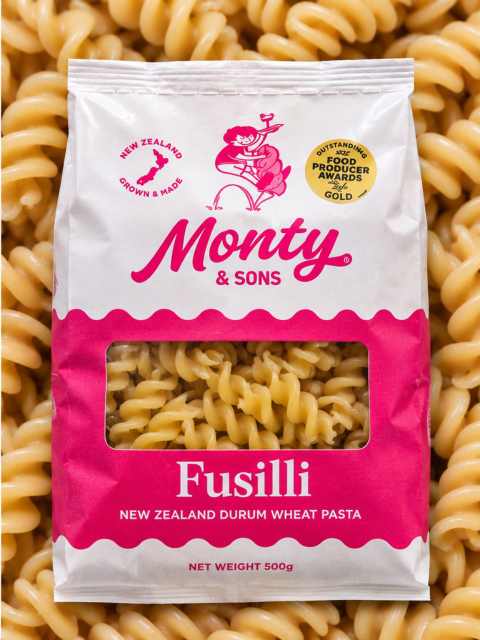
Product: Monty & Sons Fusilli, 500 g
Made with: 100% Kiwi-grown durum wheat flour
| Tested for | Result (mg/kg) |
|---|---|
| Glyphosate | <0.010 |
| AMPA | <0.05 |
| Glufosinate | <0.006 |
All three results were below the laboratory’s reporting limits.
It’s particularly pleasing to see this result from a pasta made with New Zealand-grown wheat, especially considering the measurable glyphosate residues we’ve previously found in some other wheat-based products.
2. San Remo Penne
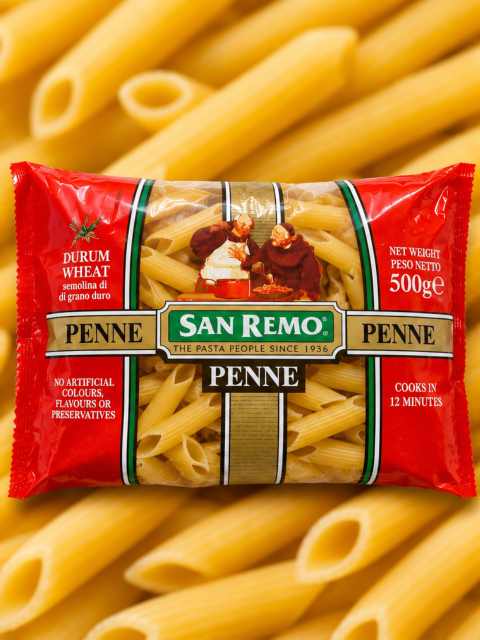
Product: San Remo Penne, 500 g
Made with: 100% Australian durum wheat semolina
| Tested for | Result (mg/kg) |
|---|---|
| Glyphosate | <0.010 |
| AMPA | <0.05 |
| Glufosinate | <0.006 |
Another encouraging result, with all three substances below their respective reporting limits.
It’s particularly encouraging to see this result from Australian-made pasta, given that Australia’s permitted glyphosate residue limit for wheat is 50 times higher than New Zealand’s — 5 mg/kg compared with 0.1 mg/kg, according to New Zealand Food Safety.
Our earlier testing also found 0.56 mg/kg of glyphosate in Australian-made Weet-Bix Multi-Grain, making this latest result an interesting contrast.
What Does “Below the Reporting Limit” Mean?
When a laboratory reports a result such as <0.010 mg/kg, it means the substance was not found at a concentration the laboratory could reliably report at or above that level.
It doesn’t necessarily mean there is absolutely none present. There could be a smaller amount below the reporting limit.
For these pasta samples, the reporting limits were:
- Glyphosate: 0.010 mg/kg
- AMPA: 0.05 mg/kg
- Glufosinate: 0.006 mg/kg
AMPA is a breakdown product of glyphosate.
The reporting limit for AMPA is higher than for glyphosate, which is worth keeping in mind when looking at the results.
A Good Result for Both Products
It’s always encouraging when our testing finds products with residues below the laboratory’s reporting limits.
As with all our independent testing, these results represent individual products from particular production batches at one point in time. They don’t necessarily reflect other batches of the same products, or what might be found in future testing.
Nevertheless, each round of testing adds another piece to the picture we’re building of glyphosate and related herbicide residues in our food.
Testing Costs & Transparency
| Item | Cost |
|---|---|
| Monty & Sons Fusilli | $10.99 |
| San Remo Penne | $3.29 |
| Hill Laboratories testing | $797.52 |
| Courier costs | $13.40 |
| Total Cost | $825.20 |
Testing just two pasta products cost $825.20, with laboratory analysis accounting for almost all of that expense. At nearly $400 per sample for laboratory testing alone, it’s easy to see why we can’t test as many products as we’d like.
Thank you to everyone whose donations make this testing possible. Your support allows us to continue independently testing everyday foods and sharing the results publicly.
No More Glyphosate NZ is an independent, community-funded initiative.
Image Source & Attribution
The original pasta product photographs were taken by No More Glyphosate NZ.
Licensed stock photography and additional graphic elements were used to create the background, with the final composition refined for publication in Canva.