As part of the No More Glyphosate NZ Council Herbicide Transparency Project, we asked councils across New Zealand about herbicide use in public spaces, the products being used, the policies governing their use, and whether those practices have been formally reviewed.
Waimate District Council provided a detailed written response describing how herbicides are used across Council-managed land, the operational framework governing their application, and the factors considered when deciding whether herbicides are used. The response also outlined notification practices, application methods, staff training requirements, and the regulatory standards relied upon for herbicide management.
The Council confirmed that glyphosate-based herbicides remain part of its vegetation management programme, that no formal trial of alternative non-chemical methods has been undertaken, and that no recent internal or independent review of herbicide use or safety has been completed.
Quick Summary
| Topic | Response |
|---|---|
| Glyphosate-based herbicides used? | Yes |
| Other herbicides used? | Yes – may be used occasionally for targeted applications |
| Alternative methods identified? | Yes – discussed but not formally trialled |
| Product list supplied? | Partial |
| Herbicide policy supplied? | No |
| SOP supplied? | No |
| Application locations identified? | Yes |
| Application frequency explained? | Yes |
| Public notification mentioned? | Yes |
| Chemically sensitive register? | Not mentioned |
| Formal review identified? | No |
| Supporting documents supplied? | No |
What We Learned
Waimate District Council advised that it uses glyphosate-based herbicides, including Roundup and Lion, for general weed control in public spaces, with other herbicides used where appropriate for targeted applications. The Council stated that all products used are approved for use in New Zealand by the Environmental Protection Authority and are applied in accordance with manufacturer label instructions and industry best practice.
Herbicide applications are undertaken by both Council staff and approved contractors. The Council stated that all applicators are required to hold Safe Handling certification, comply with NZS 8409: Management of Agrichemicals, and follow Council operational procedures and health and safety requirements.
The Council stated that herbicide use is managed through operational procedures and contract specifications rather than through a standalone herbicide policy. Copies of those procedures and specifications were not supplied.
Products Identified
| Product | Type / Active Ingredient | Notes |
|---|---|---|
| Roundup | Glyphosate-based herbicide | General weed control |
| Lion | Glyphosate-based herbicide | General weed control |
| Other herbicides | Not specified | Used for targeted applications where appropriate |
Application Locations and Frequency
The Council advised that herbicides are applied in:
- Parks and reserves
- Roadside berms and road edges
- Footpaths
- Kerb and channel areas
- Garden beds and landscaped areas
- Cemeteries
Application methods vary depending on the location and scale of the work and include:
- Hand-held knapsack sprayers
- Vehicle-mounted spray units
- Hand lance or directed spray systems
According to the Council, application techniques are selected to improve accuracy, minimise spray drift, and reduce environmental impact.
The Council advised that spraying is undertaken in response to weed growth, ambient temperature, weather conditions, and staff availability. These factors often result in spraying being completed on a cyclical basis, typically every four to eight weeks during high-growth periods, with additional reactive treatments where weed growth presents safety or amenity issues.
Policies and Guidance
The Council advised that herbicide use operates within the following legislative and operational framework:
- Hazardous Substances and New Organisms Act 1996
- Health and Safety at Work Act 2015
- Environmental Protection Authority approvals and controls
- NZS 8409: Management of Agrichemicals
Rather than maintaining a standalone herbicide policy, the Council stated that herbicide use is managed through operational procedures and contract specifications covering:
- Safe storage, handling and application
- Calibration and maintenance of spray equipment
- Staff training and competency
- Environmental protection
- Public safety considerations
The Council also advised that additional care is taken in sensitive areas including playgrounds, high pedestrian-use locations, and areas near waterways and drainage channels. Measures may include targeted application methods, reduced spray volumes, and greater operational discretion.
Public Notification and Chemically Sensitive Residents
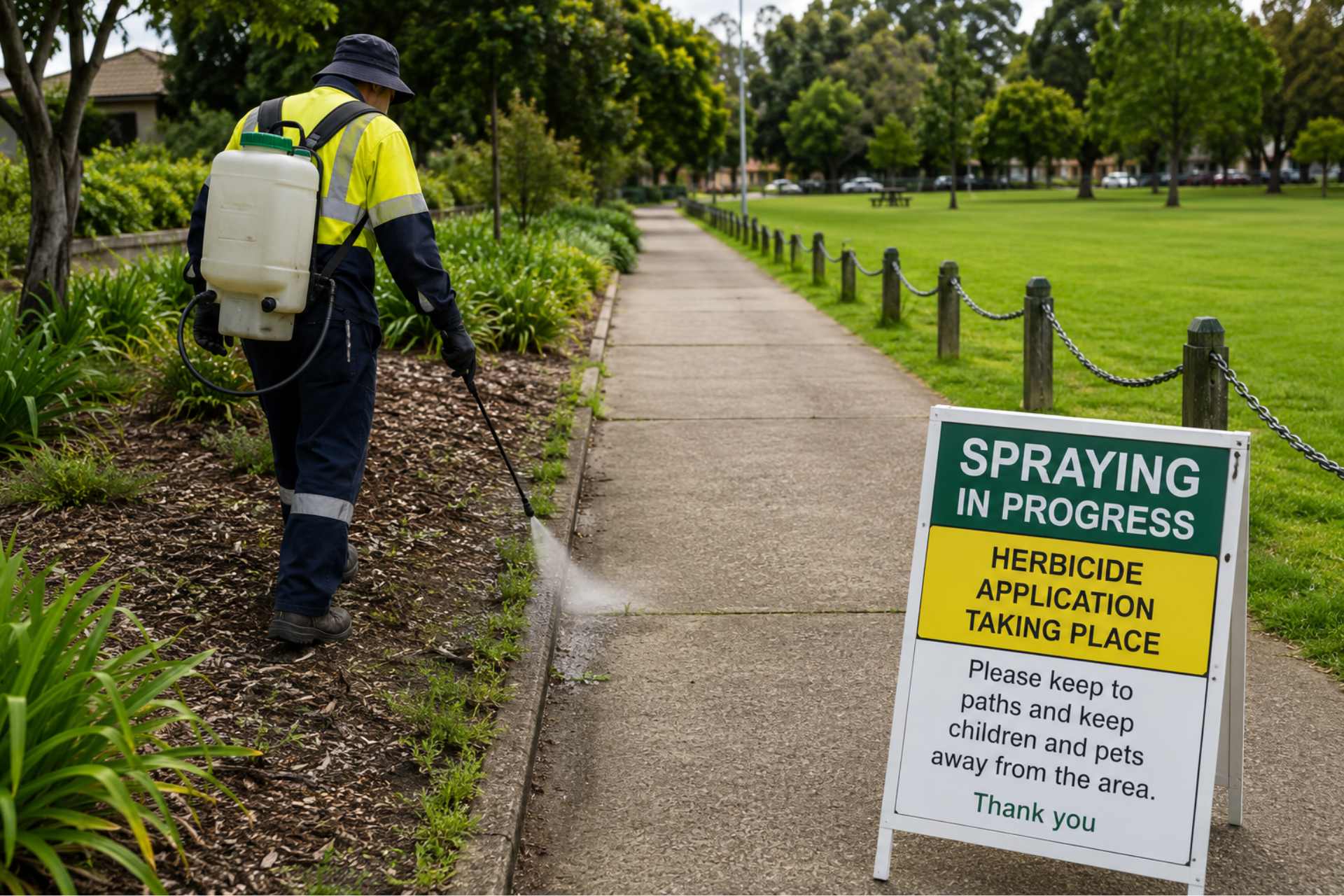
The Council advised that temporary signage is used where spraying is actively occurring or has recently been completed. Signage is intended to alert members of the public to maintenance activities.
The Council stated that staff and contractors are required to comply with the notification requirements contained within NZS 8409 and to avoid spraying during unsuitable weather conditions where spray drift may occur.
Routine herbicide programmes are not generally publicly notified in advance. However, the Council advised that it will respond to enquiries or concerns from members of the public and, where practicable, operational staff or contractors may take reasonable steps to accommodate site-specific concerns.
No chemically sensitive residents register or similar notification system was mentioned.
Review History
The Council advised that it has not undertaken a formal internal or independent review specifically relating to herbicide use or herbicide safety in recent years.
Instead, it stated that current practices are based on national regulatory approvals, recognised industry standards, operational practice, contract management, and procurement processes. These arrangements are reviewed through contract renewals and ongoing service delivery evaluations rather than through a dedicated herbicide policy review.
Observations
Waimate District Council provided a detailed narrative response addressing each section of the information request, although no supporting policies, operational procedures, contract specifications, or other documents accompanied the response.
The response places considerable emphasis on compliance with national legislation, EPA approvals, NZS 8409, staff training, and contractor management rather than on a standalone Council herbicide policy. The Council stated that its current approach has developed through operational practice, contract management, and compliance with national standards.
The Council also explicitly confirmed that no formal trial of alternative non-chemical weed management methods has been undertaken and that no formal internal or independent review specifically relating to herbicide use or safety has occurred in recent years. Mechanical removal, thermal treatments, and manual control were discussed as methods recognised within the industry, rather than as methods currently being trialled or used by the Council.
Why This Matters
Councils manage a wide range of public spaces on behalf of their communities. Understanding what products are being used, where they are applied, and how decisions are made helps contribute to greater transparency around weed management in public areas.
The Council Transparency Project aims to build a nationwide public record of herbicide management practices across New Zealand local authorities so residents can better understand what is happening in their own communities.
Information Request Details
| Item | Details |
|---|---|
| LGOIMA Reference | LGOIMA 1028 – Herbicides |
| Request Submitted | 04 May 2026 |
| Response Received | 18 May 2026 |
| Information Current | As supplied under LGOIMA on 18 May 2026 |
Image Source & Attribution
The feature image on this page was created using AI-assisted image generation from an original concept developed by No More Glyphosate NZ and refined for publication in Canva.
AI can be a useful tool, but it isn’t perfect. If you spot any inaccuracies in the features shown, please contact us and we’ll be happy to review and correct them where appropriate.