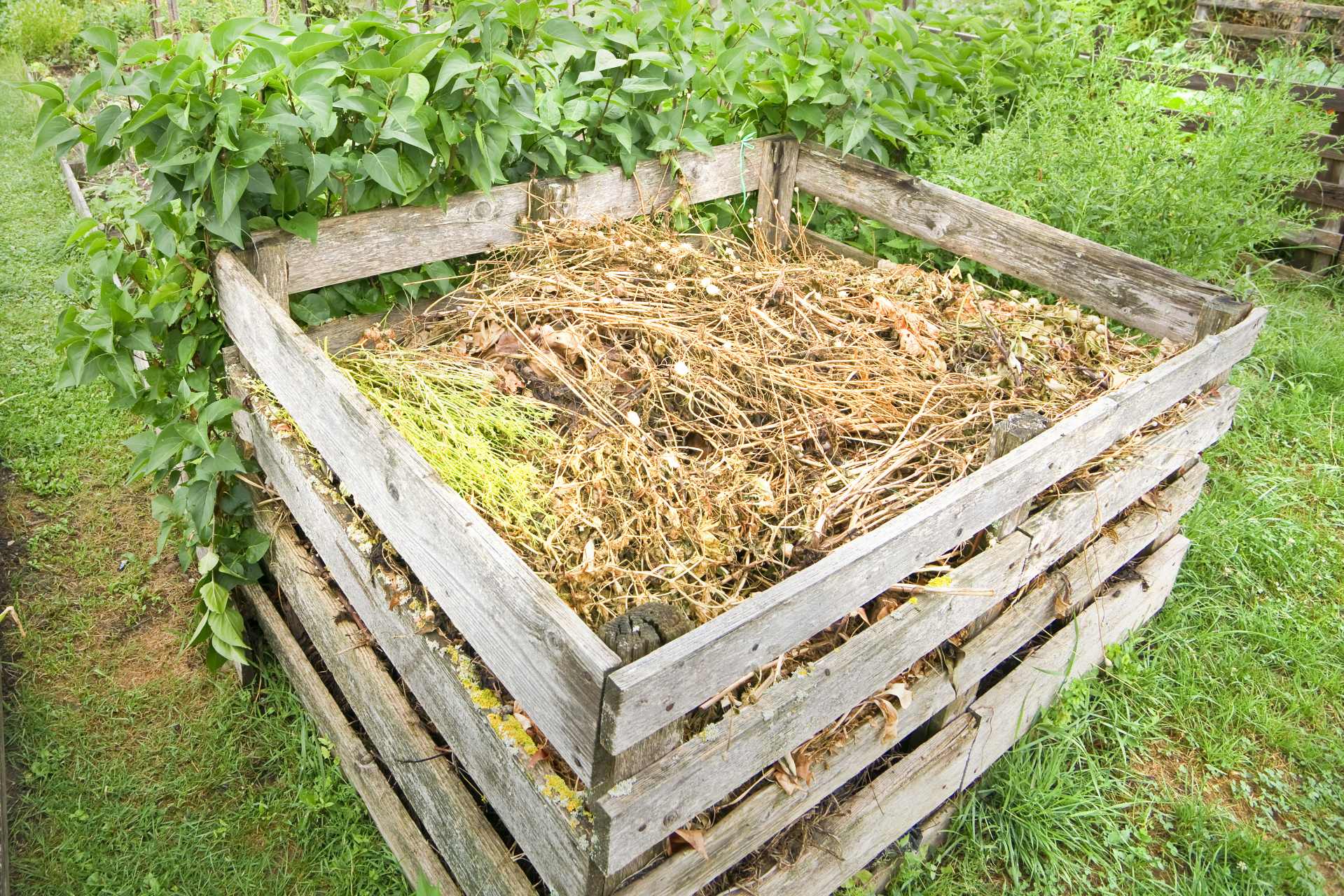
The short answer: If your aim is to make clean compost for your garden, particularly a food garden, our precautionary advice is to leave glyphosate-treated plants out.
But there is an important qualification.
We are not saying research has shown that plants sprayed with glyphosate will necessarily produce harmful compost. In fact, studies using controlled composting systems have found that glyphosate can break down substantially during composting.
The problem is that those studies don’t quite answer the question most home gardeners are asking.
We could not find good experimental research that takes whole plants previously sprayed with glyphosate, puts them into an ordinary backyard compost heap, and follows the residues through to the finished compost.
That leaves an important gap between what the research tells us and what happens in the compost heap at the bottom of the garden.
What Happens When Glyphosate Is Sprayed on a Plant?
Glyphosate is a systemic herbicide. Rather than simply killing the parts of the plant it touches, it is absorbed through the leaves and moves through the plant, including into growing tissues and roots.
That is part of what makes it effective as a weedkiller.
It also means that when a sprayed plant dies, glyphosate may still be present in the dead plant material.
One particularly relevant study looked at glyphosate in dead oilseed rape plants. The researchers added those plant residues to soil and compared what happened with glyphosate applied directly to the soil.
They found that glyphosate broke down more slowly when it entered the soil inside the dead plant material. How finely the plants were chopped also made a difference. After 80 days, some unchanged glyphosate could still be found in leaves that had not fully decomposed.
That’s useful information, but there is an important distinction.
It was a soil experiment, not a compost experiment.
It tells us that glyphosate can remain associated with dead plant material during decomposition. It does not tell us how long glyphosate would remain in those plants in a compost heap.
Does Glyphosate Break Down During Composting?
Here the picture becomes more reassuring.
Researchers have deliberately added glyphosate to organic waste and followed what happened during controlled composting.
In a 2022 study published in the Journal of Environmental Quality, researchers added either glyphosate itself or a commercial glyphosate-based herbicide to a mixture of green organic material and composted it for 112 days.
Glyphosate levels dropped substantially within the first two days and dissipation was almost complete by the end of the experiment. The researchers also did not detect AMPA, glyphosate’s main environmental breakdown product.
The glyphosate treatments had little effect on the normal composting process. A subsequent analysis of the same experiment also found no overall effect on bacterial richness or community composition.
So it would be wrong to say that glyphosate cannot be broken down by composting.
The research shows that it can.
Does Glyphosate Break Down in a Backyard Compost Heap?
This is where things become less certain.
In the controlled experiment, glyphosate and a glyphosate-based herbicide were added directly to the mixture of green residues being composted. That is different from testing whole plants that had previously been sprayed and absorbed glyphosate into their tissues before being added to compost.
The composting conditions were also carefully managed.
A backyard compost heap can be very different. Some are large, hot and regularly turned. Others are small and cool. Moisture, aeration, temperature, microbial activity and the mixture of materials can vary enormously.
That matters because all of these things influence decomposition.
So we can’t take a controlled composting experiment and confidently tell a gardener:
“Put your sprayed weeds in the compost and the glyphosate will be gone in X days.”
We don’t have the evidence to give that assurance.
How Long Does Glyphosate Take to Break Down in Compost?
This is another example of why the details matter.
Glyphosate has been reported to decline quite quickly in some types of dead plant material. In one Canadian forest study, glyphosate dissipated rapidly from leaf litter; a WHO review of the study reports a DT50 of around eight to nine days.
But leaf litter lying outdoors is not a compost heap.
Likewise, studies measuring glyphosate persistence in soil tell us about soil, not compost. And studies using carefully managed composting vessels tell us about controlled composting, not necessarily the compost bin behind your shed.
There isn’t one universal number telling us how long glyphosate remains in a dead sprayed plant under every set of conditions.
That’s why we don’t think it would be responsible to give gardeners a waiting period based on research conducted in a different setting.
Does Glyphosate Completely Disappear During Composting?
Not necessarily.
An earlier controlled composting study followed radiolabelled glyphosate during composting of sewage sludge and green waste. Some of the glyphosate was mineralised — meaning microorganisms broke it down — while another substantial portion became bound to the compost material and could no longer readily be extracted.
That does not mean those bound residues were necessarily available to plants or presented a demonstrated risk. But it is a useful reminder that terms such as “dissipated”, “degraded” and “completely gone” don’t necessarily mean exactly the same thing.
On the other hand, the later 112-day composting experiment is genuinely reassuring: glyphosate had almost completely dissipated and AMPA was not detected.
Taken together, these studies show that composting can be an effective pathway for glyphosate breakdown.
What they don’t establish is how reliably that happens when whole previously sprayed plants go into an ordinary backyard compost heap.
Can Bought Compost or Potting Mix Contain Herbicide Residues?
Gardeners sometimes report tomatoes, beans and other plants becoming twisted, stunted or dying after commercial compost or soil mixes have been added, despite the plants themselves never having been sprayed.
Herbicide contamination of compost is a recognised problem, including in New Zealand. But there is an important distinction here too.
The herbicide most closely associated with New Zealand’s so-called “killer compost” problem is clopyralid, not glyphosate.
Clopyralid behaves very differently. It can persist in treated vegetation and survive the composting process at concentrations capable of damaging sensitive plants. New Zealand’s Environmental Protection Authority has specific controls intended to keep clopyralid-treated vegetation out of both home compost and commercial green-waste systems.
In 2023, the University of Auckland’s Soilsafe Aotearoa project tested 20 commercially available composts and growing mixes for 20 herbicides, including glyphosate and clopyralid. None of the herbicides was detected.
That small survey is reassuring, although it cannot tell us what is present in every bag of compost sold in New Zealand.
Most importantly, visible herbicide-like damage to plants grown in commercial compost should not automatically be attributed to glyphosate. Different herbicides behave very differently during composting, and identifying the chemical involved requires testing.
So, Can I Compost Plants Sprayed with Glyphosate?
This brings us back to the question we started with.
Possibly — particularly if the material goes through a long, active and effective composting process.
Controlled research gives us good reason to believe glyphosate can be substantially broken down during composting.
What we cannot currently tell you is how long an ordinary backyard compost heap needs to ensure residues from whole previously sprayed plants have disappeared.
We also haven’t found good experimental evidence showing that finished backyard compost made from glyphosate-treated plants contains enough glyphosate to damage your garden.
That uncertainty cuts both ways.
There isn’t enough evidence to say “sprayed plants will contaminate your compost.”
But there also isn’t enough evidence to say “don’t worry, they’ll be fine.”
Why NMGNZ Recommends a Precautionary Approach
For many gardeners, compost is something we deliberately make because we want to return good organic material to our soil.
And if you’re growing vegetables, herbs and fruit, keeping unnecessary pesticide residues out of that system may be particularly important to you.
For that reason, No More Glyphosate NZ takes a precautionary approach: if you know plant material has recently been sprayed with glyphosate, we recommend leaving it out of your home compost, particularly compost intended for a food garden.
That is a precautionary recommendation.
It is not a claim that science has demonstrated that glyphosate-treated plants will produce harmful compost.
If future research shows that whole glyphosate-treated plants can be reliably composted under ordinary household conditions — and establishes how long that takes — gardeners will have a much clearer answer.
At present, we don’t have that research.
Glyphosate-based weedkillers are our focus at No More Glyphosate NZ, but glyphosate isn’t the only chemical worth thinking about when deciding what goes into your compost. Other herbicides can behave very differently. Clopyralid is a good example: because it can persist through composting and damage sensitive plants, the New Zealand EPA specifically says plants treated with clopyralid must not be put into compost, mulch or council green waste.
As a simple precaution, if you know garden material has been treated with a weedkiller or another potentially harmful chemical, we think it is better left out of your home compost.
What Should I Do With Glyphosate-Treated Plants Instead?
This isn’t as straightforward as simply saying “put them in the rubbish”.
Sending plant material to landfill isn’t an especially satisfying environmental solution, while commercial green-waste facilities may operate under much more effective composting conditions than the average backyard heap.
We therefore don’t think the available evidence supports a blanket claim that glyphosate-treated vegetation should never enter commercial green-waste systems. If you use a council or commercial green-waste collection, check what the operator accepts and how the material is processed.
For your own compost, however, if producing compost with the lowest practicable pesticide residues is your priority, the simplest option is not to add vegetation you know has recently been treated with glyphosate.
And avoiding glyphosate in the garden in the first place removes the question altogether.
The Bottom Line: Should Glyphosate-Treated Plants Go in Your Compost?
We know glyphosate can remain in treated plant material after the plant dies.
We also know that microorganisms can break glyphosate down and that controlled composting studies have found substantial — and in some experiments almost complete — dissipation.
What we don’t yet have is the experiment that most directly answers the home gardener’s question: what happens when whole plants previously sprayed with glyphosate are put into an ordinary backyard compost heap and left until that compost is ready to use?
Until we have that evidence, there is a limit to how confidently anyone can answer the question.
Our approach is therefore simple: if your goal is clean compost for your garden and you know plants have recently been sprayed with glyphosate, leave them out.
Not because research has proven that they will make your compost harmful.
Because research has not yet given us enough evidence to confidently say that they won’t.
Further Reading
Composting is nature’s recycling system, but what happens when the plants we return to the soil have already been treated with herbicides? These resources explore practical alternatives to glyphosate and some of the research behind what we know — and don’t yet know — about glyphosate in plants, soil and compost.
Glyphosate-Free Alternatives
Looking for ways to manage weeds without glyphosate? Browse our growing collection covering manual, thermal, mechanical and other approaches to weed management around homes, gardens, farms and public spaces.
How Long Does Glyphosate Stay in Soil? What Research Shows
How quickly glyphosate breaks down depends on soil type, temperature, moisture, microbial activity and other conditions. This article looks specifically at glyphosate persistence in soil — an important distinction from composting.
Glyphosate Fate in Soils When Arriving in Plant Residues
This 2016 Chemosphere study investigated what happened when glyphosate entered soil within treated plant residues. Glyphosate mineralisation was slower than when it was applied directly to soil, and some unchanged glyphosate remained in undecayed leaves after 80 days. Importantly, this was a soil decomposition study, not a composting experiment.
Dissipation and Effect of Glyphosate During Composting of Organic Wastes
This 2022 Journal of Environmental Quality study examined glyphosate under controlled composting conditions for 112 days. Glyphosate dissipation was almost complete by the end of the experiment and AMPA was not detected. It provides some of the strongest evidence that composting can substantially break down glyphosate — while not directly answering what happens when whole previously sprayed plants are placed in an ordinary backyard compost heap.
Image Source & Attribution
We’re grateful to the talented photographers and designers whose work enhances our content. The feature image on this page is by Audaxl.