Glyphosate-resistant weeds helped create the need for a new generation of herbicides. But what happens when weeds begin adapting to those too?
For decades, glyphosate has been one of the foundations of modern weed control. Its extraordinary success was also part of the problem.
The more extensively the same herbicide is used, the greater the selection pressure favouring weeds able to survive it. Those survivors reproduce, resistance spreads, and eventually a chemical that once seemed remarkably effective becomes less reliable.
That process is now well established with glyphosate, and it has helped create the market for the next generation of herbicides.
One of them is icafolin-methyl, Bayer’s new herbicide currently undergoing regulatory assessment in several overseas markets, including Australia, where Bayer is targeting a 2028 launch subject to approval.
Icafolin offers farmers something important: a different way of killing weeds that have become difficult to control with existing herbicides. But it also raises a much bigger question:
Does a new herbicide solve the resistance problem — or simply restart the resistance clock?
Why Glyphosate Resistance Created a Need for New Herbicides
Herbicide resistance is evolution happening in the paddock.
Within any large weed population there can be individuals with genetic characteristics that make them less susceptible to a particular herbicide. Repeatedly using that herbicide removes susceptible plants while giving the survivors an enormous competitive advantage.
Those survivors reproduce. Over successive generations, the population changes. Eventually, farmers may find that a herbicide which once provided reliable control no longer does.
Glyphosate resistance has become a serious problem in agricultural systems around the world, particularly where glyphosate has been used repeatedly over large areas and over many years.
The industry’s response has increasingly been to diversify the chemistry used against weeds. And that is where Icafolin enters the story.
Where Icafolin Fits Into the Resistance Problem
Icafolin-methyl belongs to a new chemical class known as isoxazoline carboxamides.
Unlike glyphosate, which inhibits the EPSPS enzyme in the shikimate pathway, Icafolin interferes with plant tubulin polymerisation. This disrupts the formation of microtubules that are essential to processes including cell division and plant growth.
That gives growers another way of attacking weeds that may already be resistant to other herbicides.
There is an important distinction, however. Bayer describes Icafolin as delivering the first new herbicide mode of action in more than 30 years. But the researchers who characterised Icafolin describe tubulin polymerisation inhibition itself as an established herbicidal mode of action.
What is new is Icafolin’s chemistry and biological profile — including its potency and effectiveness after foliar application.
We explain that distinction, and the science behind Icafolin, in more detail here: Icafolin — Bayer’s New Herbicide & the Next Glyphosate Alternative?
For the resistance story, however, the important point is simpler.
Icafolin gives agriculture another tool. It does not make evolution disappear.
Can Weeds Eventually Become Resistant to Icafolin?
There is no reason to assume that resistance to Icafolin is inevitable or imminent. But neither would it be reasonable to assume that a new herbicide will remain effective indefinitely simply because its chemistry is new.
Resistance develops through selection pressure. If a herbicide kills susceptible weeds while allowing plants with naturally occurring resistance traits to survive, repeated use can progressively favour those survivors.
This is why resistance management increasingly relies on combining different control methods rather than repeatedly depending on one herbicide. A new herbicide can therefore be extremely valuable.
But how it is used may ultimately matter as much as how it works.
If Icafolin becomes another chemical applied repeatedly across enormous areas, the same evolutionary forces that undermined older herbicides will still be operating.
The molecule may be new.
Evolution isn’t.
Will Icafolin Replace Glyphosate?
Probably not — and that is an important part of this story. Icafolin is better understood as another weed-control tool than as a universal substitute for glyphosate.
Glyphosate became dominant partly because of its extraordinary versatility. It has been used across cropping systems, orchards, vineyards, roadsides, public spaces and domestic settings, as well as in some countries for pre-harvest applications.
Icafolin does not simply reproduce all of those functions. Its commercial importance is more likely to come from providing growers with another way to control difficult weeds, including populations resistant to existing herbicides.
That means the future may not be glyphosate or Icafolin.
It may be glyphosate and Icafolin — alongside other herbicides.
And that changes the question.
If resistance to one chemical results in additional chemicals being layered into the system, are we reducing chemical dependence?
Or becoming more sophisticated at managing it?
The Resistance Cycle Can Lead to More Complex Chemical Systems
This is one of the paradoxes of herbicide resistance.
Resistance can encourage diversification, which is sensible from a resistance-management perspective. Using multiple modes of action can reduce reliance on any single herbicide and help preserve useful chemistry.
But over time it can also make weed-control programmes increasingly complicated. One herbicide becomes less effective. Another is introduced. Mixtures and rotations become more important. New crop technologies are developed around changing weed-control programmes. Farmers then have to manage not only the weeds but the resistance selected by decades of previous control.
The system becomes increasingly sophisticated. But it does not necessarily become less chemically dependent.
That distinction matters.
Managing herbicide resistance and reducing dependence on herbicides are not the same objective.
What About Herbicide-Tolerant Crops?
This is no longer simply something to watch.
In September 2026, Bayer announced that it is developing a sixth-generation herbicide-tolerance trait that is expected to include tolerance to Icafolin. The company describes the trait and Icafolin as part of a combined seed-and-crop-protection approach to weed control.
That matters because herbicide-tolerant cropping systems can provide farmers with powerful weed-control options: the crop survives while susceptible weeds are killed.
Glyphosate-tolerant crops showed how effective this approach could be. Farmers could use glyphosate to kill weeds without harming crops engineered to tolerate the herbicide.
But repeated use also created strong selection pressure on weeds. Plants able to survive glyphosate had an advantage and reproduced, allowing resistant populations to develop and spread. Over time, that made glyphosate less effective against some weeds.
Bayer’s Icafolin-tolerance trait is still in early-stage development, so we do not yet know what the eventual commercial system will look like. But its development makes the longer-term question increasingly relevant:
How will Icafolin and the crops designed to tolerate it be stewarded to prevent history repeating itself?
What Does Sustainable Resistance Management Actually Look Like?
There is another way to look at resistance. Instead of asking only:
Which chemical should replace the one that is failing?
we can ask:
How do we reduce the evolutionary pressure that creates resistance in the first place?
That opens a much broader toolbox.
Crop rotation can disrupt weed life cycles.
Competitive crops and cover crops can reduce the space and resources available to weeds.
Mechanical weed control can remove plants without applying the same chemical selection pressure.
Changing sowing dates, crop density and cultivation practices can make conditions less favourable for particular weeds.
Targeted and precision applications can potentially reduce unnecessary herbicide use.
And herbicides themselves can remain part of an integrated system without becoming the entire system.
None of those approaches is effortless.
Farmers operate within tight economic constraints, weather windows, labour availability, machinery requirements and market expectations. Herbicides became dominant partly because they are extraordinarily efficient tools.
The question isn’t whether farmers should simply stop controlling weeds. It is whether farming systems are more resilient when they depend on many different forms of weed control rather than repeatedly searching for the next chemical solution.
What Icafolin Reveals About the Future of Weed Control
Icafolin may prove to be an extremely effective herbicide. Its new chemistry may help farmers control weeds that have become increasingly difficult to manage. Used carefully as part of genuinely integrated weed management, it could also help reduce reliance on older modes of action.
Those are meaningful benefits. But Icafolin cannot eliminate the biological process that created glyphosate resistance.
No herbicide can.
That is why the most interesting part of the Icafolin story may not ultimately be the molecule itself. It may be what happens next.
Will a valuable new herbicide be carefully protected through diverse weed-management systems?
Or will commercial and agricultural pressures encourage increasingly widespread use until resistance once again begins eroding its effectiveness?
And if that happens, will the answer once again be another chemical?
Can Icafolin Solve Glyphosate Resistance?
Icafolin can help manage a problem created partly by glyphosate resistance. That is not the same thing as solving resistance itself.
Resistance is not a defect unique to glyphosate. It is a predictable consequence of biological populations being repeatedly exposed to the same selection pressures. New chemistry can buy agriculture valuable time.
But unless that time is used to build farming systems that place less repeated pressure on weeds in the first place, the cycle remains remarkably familiar:
Use. Selection. Resistance. New chemistry. Repeat.
Perhaps that is the real opportunity Icafolin presents: not simply another way to kill weeds, but another chance to ask whether constantly staying one chemical ahead of evolution is really where we want agriculture to be heading.
Further Reading
Icafolin may be the newest name in the resistance story, but the problem it is being developed to address is much older. The research and articles below explore the science behind Icafolin, how biological systems adapt to repeated chemical pressure, and whether increasingly sophisticated weed control is moving agriculture towards greater resilience — or simply helping it stay one step ahead of resistance.
Bayer Advances Combined Seed and Crop Protection Pipeline and Enters Phase of Blockbuster Launches
Bayer, September 2026
Bayer announces development of a sixth-generation herbicide-tolerance trait expected to include tolerance to Icafolin.
Icafolin — Bayer’s New Herbicide & the Next Glyphosate Alternative?
No More Glyphosate NZ
Explains what icafolin-methyl is, how it kills weeds, what research currently tells us about its environmental fate and safety, and whether it can genuinely be considered an alternative to glyphosate.
How Icafolin Herbicide Works — And Why It’s Not Just Another Glyphosate
No More Glyphosate NZ
Compares Icafolin and glyphosate, including their different biological targets, uses and limitations, and asks what replacing one herbicide chemistry with another means for modern farming.
The Resistance Cycle: When Biology Adapts to Human Control Systems
No More Glyphosate NZ
Looks beyond individual herbicides to examine how repeated attempts to control biological systems can drive adaptation, resistance and long-term system fragility.
Glyphosate Resistance as a Potential Driver for the Dissemination of Multidrug-Resistant Clinical Strains
Frontiers in Microbiology, 2026
Explores emerging research into whether glyphosate exposure may influence bacterial adaptation and the dissemination of antimicrobial resistance in certain environments.
Could Fence Lines and Roadsides Be Driving Herbicide Resistance?
No More Glyphosate NZ
Investigates whether repeated herbicide use outside crop fields may create additional selection pressure and contribute to resistance development.
Precision Agriculture: Smarter Farming or Smarter Chemical Dependence?
No More Glyphosate NZ
Explores whether precision technologies are helping agriculture reduce chemical dependence — or simply making chemical use increasingly targeted and efficient.
Every new herbicide buys something: another tool, another option and, potentially, more time. But what agriculture does with that time may matter more than the chemistry itself. If the response to resistance is always another chemical, perhaps the question is no longer what comes after glyphosate — but how long we can keep repeating the same cycle and calling it progress.
Image Source & Attribution
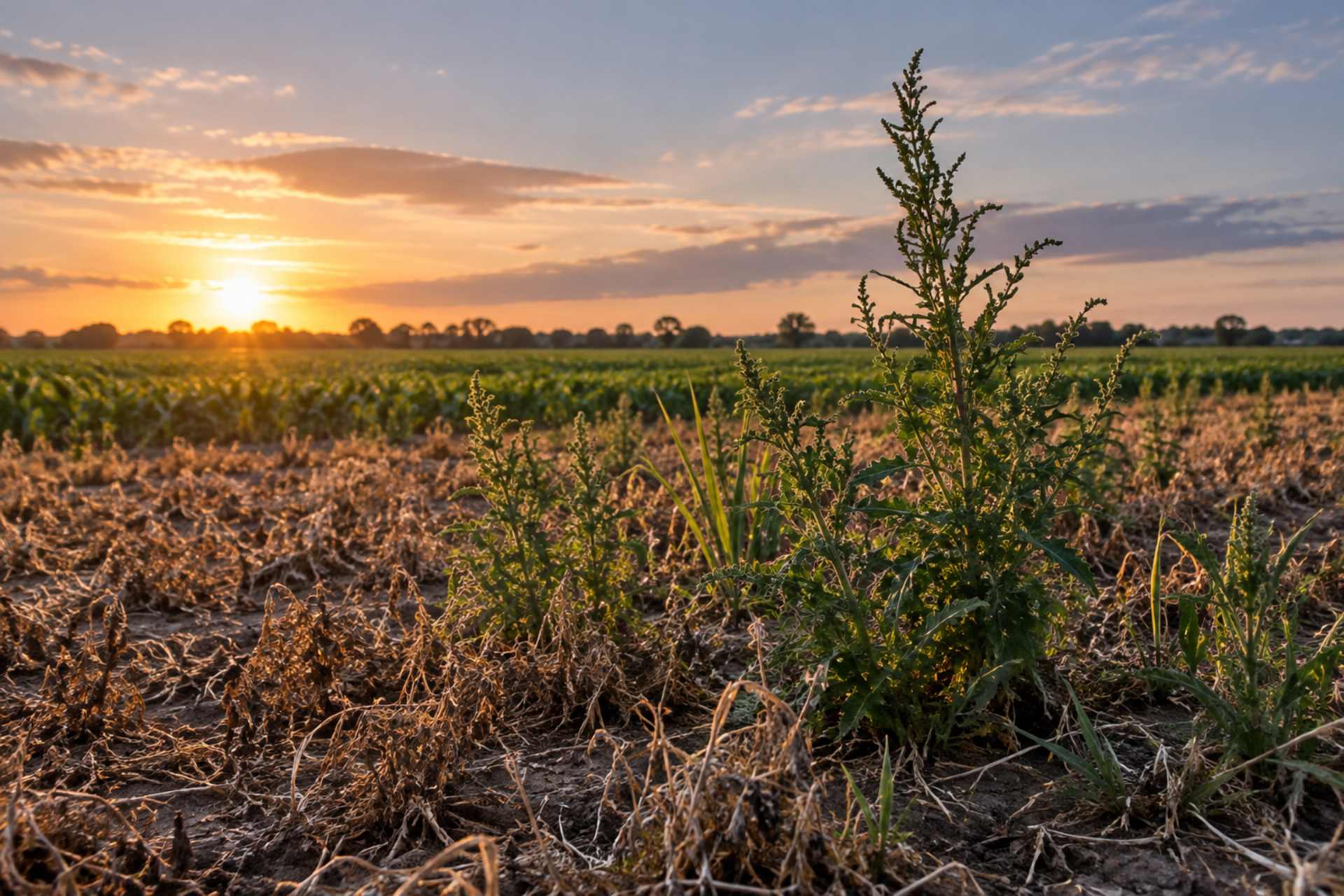
The feature image on this page was created using AI-assisted image generation from an original concept developed by No More Glyphosate NZ and refined for publication in Canva.