The word “safe” appears everywhere.
We see it in government reports, regulatory reviews, food safety assessments, news articles, product labels, and media interviews. It is often presented as the final word in a discussion, a reassuring conclusion that suggests the matter has been settled.
A chemical is safe.
A food is safe.
A product is safe.
Case closed.
But what does “safe” actually mean?
The answer may be more complicated than many people realise.
What Do Most People Mean by “Safe”?
When most people hear that something is safe, they often interpret it to mean that it is harmless.
They assume the risks have been eliminated, all important questions have been answered, and there is little reason for concern.
In everyday language, that interpretation makes sense.
If someone tells us a playground is safe, we assume children can play there without danger. If someone says a bridge is safe, we assume it is not about to collapse. If a food is described as safe, many people assume there is no meaningful risk associated with eating it.
Yet regulatory agencies often use the word differently.
What Do Regulators Mean by “Safe”?
In regulatory science, “safe” rarely means risk-free.
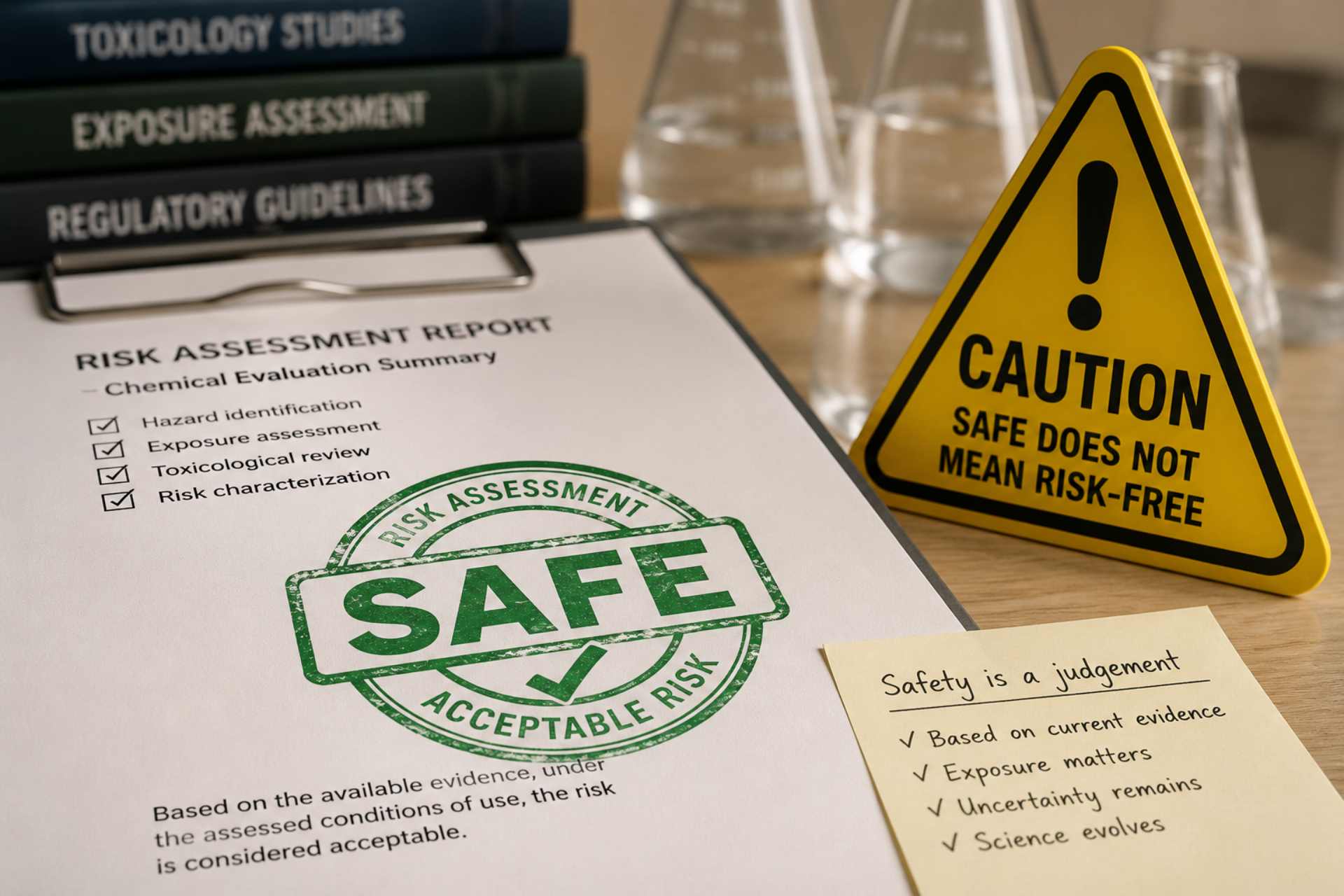
Instead, it generally means that based on the available evidence, a product, chemical, or exposure level is not expected to cause unacceptable harm under the conditions that have been assessed.
That may sound like a subtle distinction, but it is an important one.
A chemical can be considered safe within a particular exposure range while still having the potential to cause harm at higher levels.
A product can be considered safe based on current evidence while scientists continue researching additional questions.
A regulatory assessment can conclude that risks are acceptably low without claiming that every possible effect has been studied or fully understood.
In other words, regulatory safety is often a judgement about risk rather than a declaration of absolute certainty.
Why Safe Does Not Mean Risk-Free
This concept extends far beyond pesticides.
Many medicines are considered safe when used according to instructions, yet all medicines carry known side effects. Air travel is widely regarded as safe, despite the fact that accidents can occur. Driving is considered safe enough to be part of everyday life, even though risks can never be reduced to zero.
In each case, safety does not mean the complete absence of risk.
Instead, it reflects a judgement that the risks are understood, managed, and considered acceptable relative to the benefits.
Chemical regulation follows a similar principle.
Scientists conduct studies, establish exposure limits, apply safety factors, and evaluate available evidence. Regulators then determine whether expected exposures are likely to remain below levels considered harmful.
That process is designed to manage risk, not eliminate uncertainty.
How Chemical Safety Assessments Work
Another important aspect of regulatory safety is that it reflects current knowledge.
This is not a weakness of science. It is simply how science works.
Every scientific conclusion is based on the evidence available at the time. As new evidence emerges, understanding can evolve.
History provides many examples.
Lead was once widely used in petrol and paint. Asbestos was incorporated into countless building materials. Cigarette smoking was promoted by some doctors before the long-term health consequences became widely understood.
In each case, decisions were made based on the information available at the time.
As scientific understanding improved, those assessments changed.
That does not mean modern regulatory systems are equivalent to past mistakes. Today’s scientific tools are far more sophisticated than those available decades ago.
However, the underlying principle remains the same.
Scientific knowledge is never final.
It evolves as new questions are asked and new evidence becomes available.
Why Scientific Understanding Changes
One of the themes explored throughout No More Glyphosate NZ is that scientific understanding is shaped not only by the answers researchers find, but also by the questions they choose to ask.
For many years, toxicology focused heavily on issues such as cancer, acute toxicity, organ damage, reproductive effects, and developmental toxicity. These remain critically important areas of research.
More recently, researchers have increasingly explored subjects such as microbiome health, endocrine disruption, chronic low-dose exposure, cumulative exposure from multiple sources, epigenetics, and developmental windows of vulnerability.
These emerging fields do not necessarily invalidate earlier research.
However, they remind us that scientific priorities change over time.
The questions receiving attention today are not always the same questions that received the most attention decades ago.
What Does This Mean for Glyphosate?
This brings us back to glyphosate.
When regulators state that glyphosate is safe when used according to approved guidelines, they are not necessarily saying that glyphosate is harmless under all circumstances.
Nor are they claiming that future research can never change our understanding.
Instead, they are making a judgement based on the evidence available to them, the studies they consider relevant, and the risk assessment frameworks they use.
Whether consumers are comfortable with that conclusion is a separate question.
Some people are satisfied that current regulatory systems provide sufficient protection. Others prefer to minimise exposure wherever practical, particularly when scientific uncertainty remains or when new areas of research continue to emerge.
Both positions reflect different attitudes toward risk, uncertainty, and trust.
Why Consumers and Regulators View Risk Differently
Much of the public debate surrounding chemicals becomes unnecessarily polarised because people use the same word to mean different things.
One person hears “safe” and thinks “harmless.”
Another hears “safe” and understands it to mean “unlikely to cause unacceptable harm based on current evidence.”
Those interpretations are not identical.
Recognising the difference does not tell us whether a particular chemical should or should not be used.
It does, however, help create a more informed discussion about what regulatory decisions actually mean.
What Does “Safe” Really Mean?
Perhaps the debate surrounding glyphosate does not begin with the question of whether it is safe.
Perhaps it begins with a more fundamental question.
What do we mean when we use the word “safe” in the first place?
For regulators, safety is often a judgement based on evidence, exposure levels, and acceptable risk.
For many consumers, safety is something more personal. It is tied to trust, uncertainty, family health, and individual comfort with risk.
Neither perspective can be fully understood without recognising the difference between them.
Because before we can debate whether something is safe, we first need to agree on what the word actually means.
Further Reading
The debate surrounding glyphosate often focuses on a single question: is it safe?
Yet answering that question requires understanding how regulators assess risk, how scientific evidence evolves, and why different people can look at the same information and reach very different conclusions. The resources below explore the broader concepts that shape regulatory decisions and public understanding of chemical safety.
Informed Choice and Glyphosate Testing
Consumers cannot make informed choices without information. This article explores why independent testing matters, how people interpret risk differently, and why transparency remains central to meaningful consumer choice.
Glyphosate Is One of the Most Studied Herbicides in the World. Studied for What?
Glyphosate is frequently described as one of the most studied herbicides ever developed. This article examines whether the questions researchers are asking today are the same questions that shaped many current safety standards.
Glyphosate and the ADI: Are We Really Protected?
An examination of Acceptable Daily Intake (ADI) levels, how they are established, and the assumptions that underpin modern chemical risk assessment.
Chemicals in Food – Maximum Residue Limits
(FSANZ)
Food Standards Australia New Zealand explains how Maximum Residue Limits (MRLs) are established and why an MRL exceedance does not automatically indicate a food safety risk.
Acceptable Daily Intakes for Agricultural and Veterinary Chemicals
(APVMA)
A detailed overview of how ADIs are calculated, including the use of animal studies, uncertainty factors, and health-based guidance values used by regulators.
Glyphosate in Food
(New Zealand Food Safety)
New Zealand Food Safety’s official resource explaining how glyphosate residues are assessed and the rationale behind the government’s current position on glyphosate in food.
The words “safe,” “risk,” and “acceptable” appear frequently in discussions about food and chemicals, yet they often mean different things to different people. Understanding how those terms are defined—and the assumptions behind them—may be just as important as understanding the chemical itself. The more we understand how safety assessments are made, the better equipped we are to evaluate the conclusions that follow.
Image Source & Attribution
The feature image on this page was created using AI-assisted image generation based on a concept developed by No More Glyphosate NZ and refined for publication in Canva.